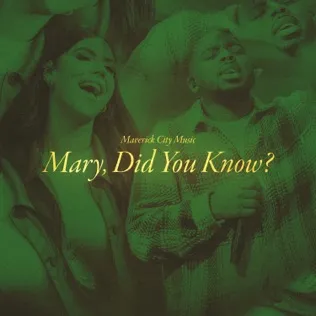
Maverick City Music - Mary Did You Know? (Radio Version) Lyrics
Lyrics
Mary did you know your baby boy
Would one day walk on water?
Mary did you know that your baby boy
Would save our sons and daughters?
Did you know that your baby boy
Has come to make you new?
This child that you've delivered
Will soon deliver you
Mary did you know that your baby boy
Would give sight to a blind man?
Did you know that your baby boy
Would calm a storm with his hands?
Did you know that your baby boy
Has walked where angels trod?
When you kiss your little baby
You've kissed the face of God
Mary did you know...
Did you know, did you know...
The blind will see, the deaf will hear
And the dead will live again
The lame will leap, and the dumb will speak
The praises of the lamb...
The blind will see, and the deaf will hear
And the dead will live again
The lame will leap, and the dumb will speak
The praises of the lamb...
Mary did you know that your baby boy
Is Lord of all creation?
Did you know that your baby boy
Would one day rule the nation?
Did you know that your baby boy
Is heaven's perfect Lamb?
And the sleeping child you're holding
Is the great I AM
Mary did you know...
Video
Mary Did You Know? (feat. Chandler Moore & Lizzie Morgan) | Maverick City Music
Meaning & Inspiration
Released on December 2, 2022, as the single "Mary Did You Know? (Radio Version)," Maverick City Music offers a compelling rendition of a modern Christmas classic, deeply enriching its already profound message. This version strips back some of the original's melancholic mystery, instead delivering a vibrant, declarative spiritual experience that encourages a fresh contemplation of the Incarnation. The song’s enduring appeal lies in its brilliant series of rhetorical questions posed to Mary, gently guiding the audience through the incomprehensible reality of the infant cradled in her arms. It explores not just what Mary might have known, but what we, too, are invited to understand about the divine identity and redemptive mission of Jesus Christ, the Son of God.
The lyrical narrative masterfully unfolds the story of Jesus's earthly ministry and divine nature from the perspective of His earliest days. The initial questions, "Mary did you know your baby boy Would one day walk on water?," immediately plunge us into the miraculous, reminding us of the Lord's power over creation, a testament found in Matthew 14:22-33. This segues into the paramount purpose of His coming: "Would save our sons and daughters?" — a direct echo of Matthew 1:21, where the angel tells Joseph, "You are to give him the name Jesus, because he will save his people from their sins," and John 3:16, declaring God's sacrificial love for the world. The poignant line, "This child that you've delivered Will soon deliver you," underscores a fundamental truth: even Mary, blessed among women, was a human being in need of a Savior, beautifully aligning with her own declaration in Luke 1:46-47, "My soul glorifies the Lord and my spirit rejoices in God my Savior."
As the song progresses, it continues to highlight the miraculous life Jesus would lead, asking, "Mary did you know that your baby boy Would give sight to a blind man?," recalling numerous New Testament accounts like the healing of the man born blind in John 9. Further emphasizing His divine authority, the lyrics prompt, "Did you know that your baby boy Would calm a storm with his hands?," evoking the dramatic scene in Mark 4:35-41 where Jesus rebuked the wind and waves. The line "Has walked where angels trod?" elevates the child’s status beyond earthly comprehension, hinting at His pre-existence and connection to the heavenly realms where angels minister before God’s throne (Isaiah 6). The profound theological statement, "When you kiss your little baby You've kissed the face of God," serves as the core revelation of the Incarnation, that God Himself took on human flesh, as affirmed in John 1:1, 14, and Colossians 2:9, which states that "in Christ all the fullness of the Deity lives in bodily form."
The bridge of the song serves as a powerful prophetic interlude, articulating the transformational impact of Jesus’s ministry: "The blind will see, the deaf will hear And the dead will live again. The lame will leap, and the dumb will speak The praises of the lamb." These lines are a direct fulfillment of Old Testament prophecies concerning the Messianic age, particularly Isaiah 35:5-6, which foretells a time when the physically afflicted will be healed and rejoice. It’s a vivid picture of restoration, both physical and spiritual, that Jesus initiated during His earthly ministry and will ultimately complete. The repeated phrase "praises of the lamb" explicitly identifies Jesus as the sacrificial Lamb of God (John 1:29, Revelation 5:12), worthy of all worship and adoration for His redemptive work.
Finally, the song crescendos to its ultimate theological climax, revealing the infant’s supreme identity and sovereignty. "Mary did you know that your baby boy Is Lord of all creation?" points to Jesus's role as creator and sustainer of the universe, as declared in Colossians 1:16-17, "For in him all things were created... and in him all things hold together." The question, "Would one day rule the nation?" anticipates His ultimate kingship and universal dominion, a promise echoed throughout Scripture, from Psalm 2 to Revelation 11:15, where the kingdoms of this world become the Kingdom of our Lord and His Messiah. "Is heaven's perfect Lamb?" reiterates His sinless nature and His role as the flawless sacrifice (Hebrews 9:14, 1 Peter 1:19). The song culminates with the awe-inspiring declaration: "And the sleeping child you're holding Is the great I AM." This directly connects the infant Jesus to the divine name revealed to Moses in Exodus 3:14 and repeatedly claimed by Jesus Himself in the Gospel of John (e.g., John 8:58), asserting His eternal, self-existent deity. This is the profound truth that underlies every miracle, every prophecy, and every act of salvation—the God of the universe, cradled in human arms.
Maverick City Music’s rendition of "Mary Did You Know?" transcends mere musical performance; it is an invitation to deeper theological reflection and worship. By focusing intently on the message, this version encourages us to ponder the immense paradox of the Incarnation—the infinite becoming finite, the Creator entering His own creation as a vulnerable baby. It challenges us to move beyond familiar narratives and genuinely grasp the divine identity and saving mission of Jesus Christ, fostering a renewed sense of awe and gratitude for the miracle of Christmas, and indeed, for the entirety of God's redemptive plan. This song serves as a powerful catalyst for personal contemplation, urging us to recognize the profound truth that every aspect of Jesus’s life, from His birth to His resurrection, was a testament to His nature as the Son of God, the Great I AM.