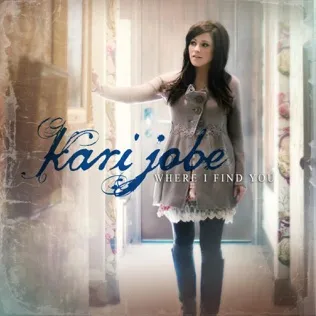
Kari Jobe - Steady My Heart Lyrics
Lyrics
Wish it could be easy
Why is life so messy?
Why is pain a part of us?
There are days I feel like
Nothing ever goes right
Sometimes it just hurts so much
But You're here
You're real
I know I can trust You
Even when it hurts
Even when it's hard
Even when it all just falls apart
I will run to You
'Cause I know that You are
Lover of my soul
Healer of my scars
You steady my heart [x2]
I'm not gonna worry
I know that You've got me
Right inside the palm of your hand
Each and every moment
What's good and what gets broken
Happens just the way You plan
You are here
You're real
I know I can trust You
Even when it hurts
Even when it's hard
Even when it all just falls apart
I will run to You
'Cause I know that You are
Lover of my soul
Healer of my scars
You steady my heart [x2]
And I will run to You
And find refuge in Your arms
And I will sing to You
'Cause of everything You are
You steady my heart [x2]
Even when it hurts
Even when it's hard
Even when it all just falls apart
I will run to You
'Cause I know that You are
Lover of my soul
Healer of my scars
You steady my heart [x2]
I'm not gonna worry
I know that you've got me
Right inside the palm of your hand
Video
Kari Jobe - Steady My Heart
Meaning & Inspiration
Kari Jobe’s "Steady My Heart" hits a nerve that most congregational singing prefers to avoid: the friction between a sovereign God and a chaotic life. It begins with a blunt inquiry—Why is life so messy? Why is pain a part of us?—and that is where the weight of the song rests. We spend so much time sanitizing our lyrics that when we finally admit that things don't go right, it feels like a theological breach. But Jobe’s admission is actually an exercise in honesty that Job himself would recognize.
There is a line that invites scrutiny: Each and every moment / What’s good and what gets broken / Happens just the way You plan.
I find myself stopping here every time. It is a bold, perhaps reckless, claim about Providence. It nudges against the problem of evil with a confidence that can feel jarring. If we anchor this to the doctrine of Divine Concurrence—the idea that God is active in every event, holding atoms together while permitting the fall's corruption to run its course—the lyric gains a massive, terrifying gravity. It suggests that our brokenness isn't a glitch in the divine software, but something subsumed under a broader, albeit painful, design.
Some might call this simplistic or overly deterministic, yet there is a brutal comfort in it. If our suffering is purely random, we are orphans in a cruel universe. If it is "planned" in the sense of being held within the grip of the One who endured the cross, it becomes a vessel for redemption.
The title—"You steady my heart"—serves as the necessary counterweight. The human heart is, by nature, unquiet. It is fickle, prone to idolatry, and easily fractured by the reality of a fallen world. To ask for steadiness is to acknowledge that we are not self-sufficient. We are not our own anchors. When the world breaks, the heart begins to drift toward despair or bitterness. Jobe captures the desperation of the believer who knows they have nowhere else to go.
It’s easy to sing about peace when the bills are paid and the health reports are clean. It is quite another thing to lean into the Imago Dei when everything is unraveling. The song doesn't solve the "why" of our pain; it doesn't offer a philosophical treatise on theodicy. Instead, it moves from the messy question to the act of running.
Maybe that is where the theology actually lives. We don't need a perfectly airtight answer to every tragedy before we can approach the throne. We need to know that the God who plans the arc of history is the same God who is near enough to catch the fragments of our lives. It leaves me wondering: can we truly trust the "Lover of our soul" if we refuse to accept the sovereignty of the hand that permits the break? It is a tension that never quite resolves, and perhaps that is exactly where we are supposed to stand.