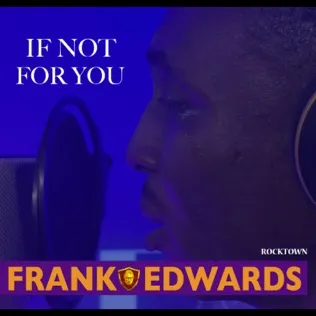
Frank Edwards - If Not For You Lyrics
Lyrics
If not for You
Where would I be today
If not for You
Who would have saved my life
If not for You Idinma
If not for You Omega
My creator I keep praising You
Jesus I'll keep praising You
If not for You Jehova
Alpha Omega
I'll keep praising You
Video
Frank Edwards - IF NOT FOR YOU #frankedwards #rocktown #gospelmusic #ifnotforyou
Meaning & Inspiration
Frank Edwards doesn’t waste breath here. In an industry obsessed with bridge-building and production sprawl, this track is a lean, honest interrogation of one’s own history.
The song functions as a ledger. It isn’t trying to convince you of God’s goodness; it’s asking the listener to audit their own life. When Edwards sings, "If not for You, where would I be today?" he isn’t asking a rhetorical question for a choir to hum along to. He’s staring at a gap—a hypothetical void where his life, his sanity, or his identity might have dissolved. It’s a terrifying thought if you hold it long enough.
The Power Line: "If not for You, who would have saved my life?"
This works because it strips away the ego. In the context of modern faith, we often talk about God as a partner or a consultant. Here, Edwards positions God as a Rescuer—a lifeguard pulling someone from a riptide. It pulls the track out of the realm of abstract theology and into the mud of survival. It echoes Psalm 124:2: "If the Lord had not been on our side—let Israel say—if the Lord had not been on our side when people attacked us, they would have swallowed us alive." It acknowledges that there was a moment where the "swallowing" was a genuine possibility.
The back half of the track settles into a repetitive loop: "I'll keep praising You."
From an editorial standpoint, this borders on redundant. But if you listen closely, the repetition isn't filler; it’s stubbornness. It’s the sound of someone refusing to let go of a lifeline. When you’ve been brought back from the edge, your vocabulary shrinks. You don't need fancy metaphors. You need a singular, repetitive action to keep your feet on solid ground.
There’s a tension here that stays unresolved. He doesn't explain what he was saved from. He doesn't give us the backstory. He leaves us in the middle of his gratitude, standing in the middle of a life that shouldn't be here. It’s uncomfortable, in a way. Most music demands you understand the artist's narrative, but Edwards denies us the voyeurism of his trauma. He only offers the resolution.
It leaves me wondering: if I were to strip away the noise of my own day-to-day, would I have the same singular focus? Or am I still trying to bargain with the Rescuer? Edwards doesn't give a polite answer, and frankly, I don’t think he owes us one. He’s just calling the roll, counting the cost, and choosing the only response that makes sense when you know you shouldn't have made it through the night.