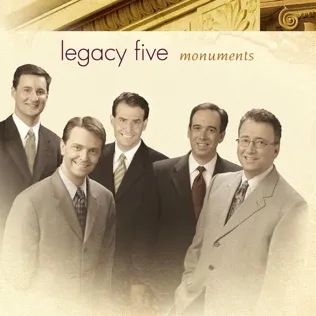
Legacy Five - Monuments Lyrics
Lyrics
VS 1
God's people stood on the river of Jordan
Looking back on the water they had passed through
They shouted and raised their voices to heaven
But Joshua said there's one thing we must do
VS 2
They laid twelve stones on the banks of the river
At Gilgal they offered their tribute that day
Their children would question them "what are these stones?"
"Child they mark the spot of this sanctified day"
Chorus
Where are the monuments we should be leaving
so our children can find the way to get home
We should be laying stones so they can follow
the pathway that leads to God's throne.
VS 3
Mothers and fathers of this generation
there's hope for your family keep this in mind
Don't move the landmarks set up for your children
they will find the way by what we've left behind.
REPEAT CHORUS
Video
Monuments-Legacy Five
Meaning & Inspiration
Legacy Five's profoundly moving track, "Monuments," from their album of the same name, released on October 26, 2004, stands as a powerful call to spiritual stewardship and generational discipleship. The song wastes no time in drawing a vivid parallel from the Old Testament, recounting the Israelites' crossing of the Jordan River. This foundational story, detailed in the book of Joshua, specifically Joshua chapters 3 and 4, describes how God miraculously parted the waters, allowing His people to walk across on dry ground. Immediately following this incredible display of divine power, Joshua, at God's command, instructed twelve men—one from each tribe—to take a stone from the riverbed and set them up as a memorial at Gilgal. These stones were not merely decorative; their explicit purpose, as articulated in Joshua 4:6-7, was to serve as a tangible reminder for future generations, so that when children asked, "What do these stones mean?" their parents could recount the Lord's mighty works.
"Monuments" skillfully transports this ancient narrative into a modern-day context, urging mothers and fathers of our own time to consider the spiritual legacy they are cultivating. The central question posed by the song – "Where are the monuments we should be leaving so our children can find the way to get home?" – resonates deeply, challenging us to reflect on the intentional steps we are taking to guide our families toward faith. It’s a direct application of the biblical mandate found in Deuteronomy 6:6-7, where parents are commanded to diligently teach God's commandments to their children, speaking of them when they sit in their house, when they walk by the way, when they lie down, and when they rise up. The song encourages us to "lay stones," metaphorical markers of faith, truth, and obedience that point directly to God's throne, signifying His sovereignty and our ultimate destination.
The final verse serves as an urgent yet hopeful exhortation to this current generation of parents, reminding them of the enduring impact of their actions and beliefs. It speaks to the wisdom of not "moving the landmarks set up for your children," a poignant echo of Proverbs 22:28, which warns against altering ancient boundary markers. In the song's spiritual context, these landmarks represent the established truths of Scripture, the moral principles, and the foundational practices of faith that, when upheld, provide a clear, unwavering path for the next generation. The message here is profoundly clear: our children will not stumble in darkness if we faithfully illuminate the way through our unwavering commitment to God's Word and our consistent demonstration of a life lived for Him. Our "monuments" are not literal piles of rock, but rather the intentional teaching of Scripture, the consistent example of prayer and worship, the practice of forgiveness, the pursuit of justice, and the active love shown within our homes and communities. These are the powerful testimonies that speak volumes across generations, guiding our children and grandchildren back to the source of all life and truth. The song ultimately serves as a powerful reminder that passing on faith is not just an option but a sacred duty, ensuring that the pathway to God's throne remains clear and accessible for all who follow.