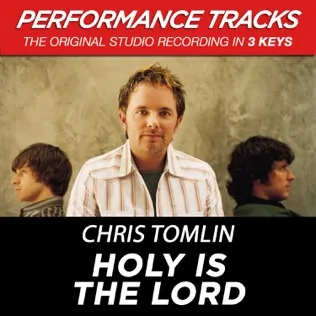
Chris Tomlin - HOLY IS THe LORD GOD ALMIGHTY Lyrics
Lyrics
"We stand and lift up our hands For the joy of the Lord is our strength We bow down and worship Him now How great, how awesome is He And together we sing Everyone sing
Holy is the Lord God Almighty The earth is filled with His glory Holy is the Lord God Almighty The earth is filled with His glory The earth is filled with His glory
We stand and lift up our hands For the joy of the Lord is our strength We bow down and worship Him now How great, how awesome is He And together we sing Everyone sing
Holy is the Lord God Almighty The earth is filled with His glory Holy is the Lord God Almighty The earth is filled with His glory The earth is filled with His glory It's rising up all around It's the anthem of the Lord's renown
Video
Chris Tomlin - Holy Is The Lord (Lyrics And Chords)
Meaning & Inspiration
Chris Tomlin’s Holy Is The Lord is a curious piece of work. As an editor, I’m constantly cutting the "fluff" from manuscripts, and this track leans heavily on repetition. It’s built for a crowd, not a solitary headphone listener. Does it repeat itself to fill time? Absolutely. The chorus loops until the sentiment is driven home, then loops again just to be certain you didn’t miss it. It’s functional, utilitarian worship music.
But there is a specific friction in the lyric, "The earth is filled with His glory."
When you sing that in a quiet room, or in a chaotic city street, it feels like a lie. Or at least, a stretch. We look at the news, we look at our own bank accounts or broken relationships, and "filled with glory" feels like a poetic exaggeration. Yet, Scripture doesn’t blink when it makes the claim. Isaiah 6:3, which this song leans on, is the cry of seraphim—creatures that exist in a reality where the veil is entirely stripped away.
The tension lies in the gap between our perception and that reality. When Tomlin sings that the glory is "rising up all around," he’s trying to bridge that gap. He’s asking the listener to choose a perspective that contradicts their immediate visual data. It’s an exercise in discipline, forcing the mind to look past the surface noise of life.
The 'Power Line' here is: “For the joy of the Lord is our strength.”
It works because it’s logically counter-intuitive. In a normal human experience, strength usually produces joy—I work hard, I achieve, I feel good. Here, the sequence is inverted. Joy is the catalyst, not the output. It suggests that if you can find a way to access the delight of God’s nature, you suddenly possess the energy to handle whatever is crushing you. It’s not about positive thinking; it’s about tethering your stability to something that isn’t shifting.
Still, I find myself hung up on the repetition. Is it an anthem, or is it just a mantra meant to drown out the doubt? There is a thin line between singing to remember a truth and singing to suppress a question. When the song hits its peak, I’m never quite sure if the congregation has reached a place of profound revelation, or if they’re just caught in the momentum of a well-structured crescendo.
Maybe that’s the point. Faith often looks like doing the thing until the feeling catches up. We lift our hands because our internal state is currently empty, hoping the physical gesture drags the heart along with it. It’s a messy, repetitive process, but perhaps that’s how we eventually convince ourselves that the earth is, in fact, filled with His glory.