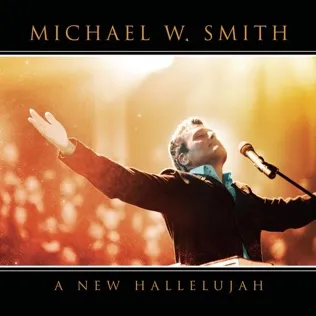
Michael W. Smith - A New Hallelujah Lyrics
Lyrics
Can you hear, there's a new song
Breaking out from the children of freedom
Every race and every nation
Sing it out sing a new Hallelujah
Let us sing love to the nations
Bringing hope of the grace that has freed us
Make Him known and make Him famous
Sing it out sing to the new Hallelujah
Arise
Let the church Arise
Let love reach to the other side
Alive come alive
Let the song Arise
Africa sings a new song
Reaching out with the new Hallelujah
Every son and every daughter
Everyone sing a new Hallelujah
Arise
Let the song Arise
Let love reach to the other side
Alive come alive
Let the song Arise
Let the song arise...
Let the world sing a new Hallelujah
From Africa to Australia
From Brazil to China
From New York down to Houston
Arise
Let the church Arise
Let love reach to the other side
Alive come alive
Let the song Arise
Everyone sing a new Hallelujah
Video
Michael W. Smith - A New Hallelujah (Live)
Meaning & Inspiration
"Make Him known and make Him famous."
There it is. Tucked into the middle of Michael W. Smith’s A New Hallelujah, that singular line acts as a fulcrum for the entire composition. It’s a jarring word choice, isn't it? "Famous." In our current cultural currency, fame is a commodity—a pursuit of likes, visibility, and the ego-stroking buzz of being recognized by a crowd. We spend our lives trying to make ourselves famous, or trying to stay relevant enough to survive. To attach that specific verb to the Creator of the universe feels almost irreverent at first glance.
Literally, to make someone famous is to increase their public awareness. It’s a marketing term. But spiritually? It’s a radical proposition. It suggests that the God of the Bible is suffering from a lack of PR, which is obviously absurd to anyone who has stared at the stars or felt the weight of a guilty conscience. Yet, the psalmist writes in Psalm 145:6, "They shall speak of the might of your awesome deeds, and I will declare your greatness."
Is it a cliché? Perhaps. We’ve grown accustomed to the phrase in the worship circuit. But if I strip away the rhythm and the arena-fillers' delivery and just look at the ink, it stops being a slogan and starts being a demand. If I am truly "making Him famous," then my life—not just the song I’m singing—becomes a billboard. And that’s where the tension lies. Am I making Him famous, or am I just using the language of fame to build a platform for my own spiritual identity?
There’s an uncomfortable collision here between the global scale Smith describes—mentioning Africa, Australia, Brazil—and the personal command to "make Him famous." It’s easy to sing about global evangelism. It’s easy to project a vision of nations singing in unison. It’s much harder to consider what happens when "making Him famous" requires me to shrink so that He might be seen.
The song asks the church to "Arise." It implies a posture of movement. Yet, I find myself sitting still, questioning why we are so obsessed with the visibility of the Divine. Does He need us to make Him famous? Or is this just our way of trying to manage a God who is fundamentally unmanageable?
Maybe the revelation isn't that we have the power to make Him a celebrity, but that we have been invited to participate in the broadcast of His character. It’s not about the reach of the song; it’s about the truth of the lyrics—that grace exists. If I sing "make Him famous" and my neighbor remains unaware of the grace that set me free, then the word is hollow. It remains a cliché. But if the "famous" aspect simply means He is the primary topic of my existence, then it’s an indictment of my own silence. I’m left wondering if I’m capable of that kind of public, messy, uncool devotion.