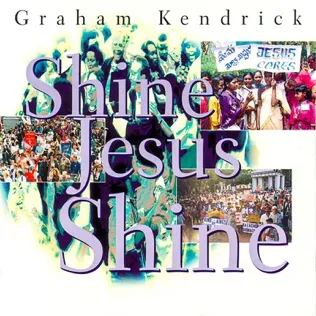
Graham Kendrick - I Will Build My Church Lyrics
Lyrics
I will build my church (Men)
I will build my church (Women)
And the gates of hell (Men)
And the gates of hell (Women)
Shall not prevail (Men)
Shall not prevail (Women)
Against it (All) (Repeat)
So you powers in the heavens above bow down!
And you powers on the earth below bow down!
And acknowledge that Jesus, Jesus
Jesus is Lord, is Lord
Video
I Will Build My Church - Graham Kendrick
Meaning & Inspiration
Graham Kendrick’s "I Will Build My Church," released on April 4, 1988, as part of his seminal album *Shine Jesus Shine*, stands as a powerful declaration of Christ’s unwavering promise and His sovereign authority. This song is not merely a tune but a vibrant theological statement, drawing directly from the very words of Jesus Himself, offering a bedrock of assurance to all who believe.
The song’s profound meaning originates from a pivotal moment in Scripture, specifically Matthew 16:18, where Jesus tells Peter, “And I tell you that you are Peter, and on this rock I will build my church, and the gates of Hades will not overcome it.” This divine pronouncement forms the entire narrative arc of Kendrick’s composition. It speaks to the foundation of the Christian faith: the establishment of God’s ekklesia—the called-out assembly of believers—not by human effort or design, but through the active, steadfast will of Christ Himself. The song emphasizes that the Church is His initiative, His construction, and His responsibility, providing immense comfort and confidence to its members across generations.
Delving into the declaration, "I will build my church, and the gates of hell shall not prevail against it," we encounter a truth both profound and empowering. The "church" here transcends any physical edifice; it refers to the living, breathing community of believers, united under Christ’s headship. Jesus, the master builder, guarantees its construction and endurance. The phrase "gates of hell" is often misunderstood as hell's defense, but Biblically, gates are positions of power and authority from which cities launch their attacks or conduct their business. Thus, the promise signifies that the offensive strategies, the formidable might, and the very dominion of death and spiritual darkness will be utterly incapable of stopping the Church's advance or its ultimate triumph. Christ’s victory over death and the grave, as declared in 1 Corinthians 15:54-57, and His power over spiritual forces, echoed in Colossians 2:15, underpin this assurance. The Church is not passively weathering a storm; it is an active force, marching forward, with divine authority that even the strongest forces of evil cannot withstand.
The subsequent lines, "So you powers in the heavens above bow down! And you powers on the earth below bow down!" shift the focus from a foundational promise to an authoritative command. This is a bold pronouncement of Christ’s absolute supremacy over all creation, visible and invisible. It speaks directly to the spiritual forces described in Ephesians 6:12—the principalities, powers, rulers of darkness, and spiritual wickedness in high places—as well as earthly authorities that might oppose God’s kingdom. This is not a request but a sovereign decree. Every entity, every influence, every authority, whether heavenly or earthly, is commanded to submit to the unparalleled Lordship of Jesus. This aligns with Philippians 2:10-11, which proclaims that "at the name of Jesus every knee should bow, in heaven and on earth and under the earth." It is a powerful reminder that all opposition, no matter how formidable it appears, ultimately operates on borrowed time and under the pre-eminence of Christ.
The culmination of the song, "And acknowledge that Jesus, Jesus Jesus is Lord, is Lord," solidifies the entire message. This is the central confession of Christian faith, the very bedrock upon which salvation is built, as highlighted in Romans 10:9. It is the inescapable truth that all creation will ultimately confront and confess. Whether through voluntary worship or compelled submission, the universe will affirm that Jesus Christ holds supreme authority. His Lordship is not merely a title; it is a declaration of His absolute sovereignty, His divine nature, and His ultimate reign established through His resurrection and ascension. This declaration not only humbles every opposing power but also empowers believers, grounding them in the assurance that their Savior is the undisputed King of kings and Lord of lords.
"I Will Build My Church" remains a profoundly relevant and inspiring piece. It serves as a vital reminder for believers today that the Church is not a fragile human institution but a divine edifice, secured by the unshakeable promise and irresistible power of Jesus Christ. It calls us to remember our foundational identity, embrace our God-given authority, and boldly declare the universal Lordship of our Savior. Through its simple yet profound lyrics, Graham Kendrick has crafted a timeless anthem that fortifies faith, ignites hope, and fosters a deeper understanding of Christ’s enduring commitment to His people, encouraging us to stand firm in the knowledge that His church will indeed prevail.