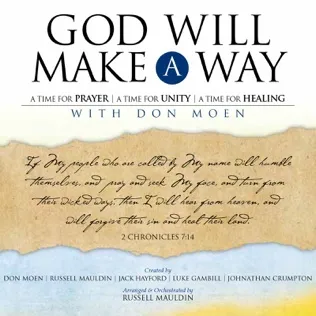
Don Moen - Prayer Lyrics

Album: God Will Make a Way: A Worship Musical
Released: 13 May 2003
iTunes Amazon Music

Lyrics

Lord make us instruments of Your peace

Where there is hatred let Your love increase

Lord make us instruments of Your peace

Walls of pride and prejudice shall cease

When we are Your instruments of peace


Lord make us instruments of Your peace

Where there is hatred let Your love increase

Lord make us instruments of Your peace

Walls of pride and prejudice shall cease

When we are Your instruments of peace


Where there is hatred we will show His love

Where there is injury we will never judge

Where there is striving we will speak His peace

To the millions crying for release

We will be His instruments of peace


Lord make us instruments of Your peace

Where there is hatred let Your love increase

Lord make us instruments of Your peace

Walls of pride and prejudice shall cease

When we are Your instruments of peace


Where there is blindness we will pray for sight

Where there is darkness we will shine His light

Where there is sadness we will bear their grief

To the millions crying for release

We will be Your instruments of peace


Lord make us instruments of Your peace

Where there is hatred let Your love increase

Lord make us instruments of Your peace

Walls of pride and prejudice shall cease

When we are Your instruments of peace

Walls of pride and prejudice shall cease

When we are Your instruments of peace

Video

Don Moen - Our Father | Live Worship Sessions

Thumbnail for Prayer video

Meaning & Inspiration

Don Moen’s “Prayer,” released on May 13, 2003, as part of his album *God Will Make a Way: A Worship Musical*, stands as a profound call to spiritual action, echoing the timeless sentiment of the Peace Prayer of Saint Francis. The song immediately establishes itself not as a performance, but as a collective supplication, a yearning for believers to embody the very essence of divine peace in a fractured world. It frames the human experience as an opportunity for ministry, moving beyond passive belief to active participation in God's restorative work. The repeated appeal, "Lord make us instruments of Your peace," isn't merely a request but a declaration of purpose, underscoring a desire to be conduits of grace in every interaction.

The lyrical narrative of "Prayer" unfolds as a commitment to counter worldly brokenness with Christ-like responses. Where animosity festers, the song pledges that God's love will prevail, directly challenging the human tendency towards division. This aspiration aligns powerfully with the divine command found in John 13:34, where Jesus instructs His followers, "A new commandment I give to you, that you love one another: just as I have loved you, you also are to love one another." The song envisions a world where "walls of pride and prejudice shall cease," a spiritual dismantling of barriers that resonate with Paul's declaration in Galatians 3:28 that "there is neither Jew nor Gentile, neither slave nor free, nor is there male and female, for you are all one in Christ Jesus." It's a vision of unity, humility, and the overcoming of societal divides through the transformative power of faith, remembering how God "resists the proud but gives grace to the humble" (James 4:6).

Further into its powerful message, "Prayer" outlines specific ways believers can actively manifest peace. It asserts that "where there is injury we will never judge," reflecting Jesus' caution against condemnation in Matthew 7:1-2, urging a spirit of understanding and mercy. In moments of conflict, "where there is striving we will speak His peace," embodying the peacemaker's role described in Matthew 5:9: "Blessed are the peacemakers, for they shall be called children of God." This isn't a passive withdrawal from discord but an active engagement aimed at reconciliation and calm, recognizing that "if it is possible, as much as depends on you, live peaceably with all men" (Romans 12:18). The song expands its compassionate scope to "the millions crying for release," acknowledging the widespread suffering and longing for deliverance that echoes the prophetic mission in Isaiah 61:1, a passage Jesus Himself quoted: "to proclaim liberty to the captives and freedom to the prisoners."

The profound dedication continues by addressing various forms of human affliction. The plea that "where there is blindness we will pray for sight" speaks not only to physical sight but also spiritual discernment, a turning "from darkness to light" as described in Acts 26:18, allowing individuals to truly see God's truth. In response to spiritual darkness, "where there is darkness we will shine His light," fulfilling the biblical mandate for believers to be "the light of the world" (Matthew 5:14), guiding others to the path illuminated by Christ, the true "light of the world" (John 8:12). Moreover, "where there is sadness we will bear their grief," reflecting the empathetic command to "bear one another’s burdens, and thereby fulfill the law of Christ" (Galatians 6:2) and to "rejoice with those who rejoice; mourn with those who mourn" (Romans 12:15). Don Moen's "Prayer" therefore stands as a vibrant testament to the practical application of Christian faith, transforming abstract theology into a tangible mission of compassion, unity, and restorative peace, encouraging every individual to become a living embodiment of God's love and grace in a world desperately needing both.

Loading...
In Queue
View Lyrics