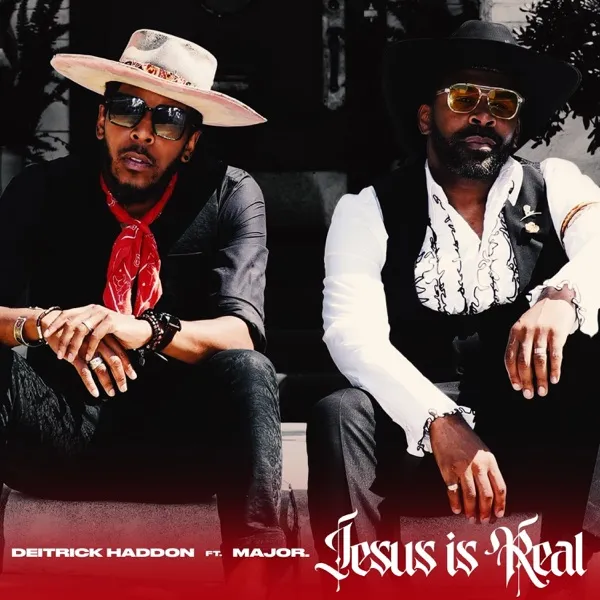
Deitrick Haddon - Jesus Is Real Lyrics
Lyrics
If the sun ever refuse to shine I'll still have faith in you
And if the moon ever refuse to glow I just want you to know I'll still believe in you
Jesus is real Real in my soul For he has washed And made me whole Jesus is real Real in my soul Gave me another chance He made me whole Jesus is real
And if the ocean ever refuse To make anymore waves I will wave my hands to you
If this ratchet world should ever chose To put Jesus on trial again I will, I'll testify to you
Jesus is real Real in my soul For he has washed And made me whole Jesus is real Real in my soul Gave me another chance...
Yes, Jesus is real... Oh, Jesus is real...
Jesus is real Real in my soul Gave me another chance...
Jesus is real
Video
Deitrick Haddon x Major - Jesus Is Real [Official Video]
Meaning & Inspiration
Deitrick Haddon has always operated with one foot in the sanctuary and one foot in the streets, and Jesus Is Real is a masterclass in how he maneuvers that friction. He isn’t trying to reinvent the wheel here; he’s taking the cadence of old-school quartet gospel—the kind you’d hear at a revival on a sweltering Tuesday night—and dressing it in a modern, mid-tempo groove that doesn't feel like it’s trying too hard to please the radio gods.
There’s a line in the second verse that caught me off guard: "If this ratchet world should ever choose to put Jesus on trial again / I will, I’ll testify to you."
That word—ratchet—is doing a lot of heavy lifting. It’s a bold linguistic choice. In the context of contemporary gospel, many artists are sanitized to the point of being unrecognizable to the people they’re actually singing to. Haddon uses the vernacular of the culture to frame the weight of the gospel. He’s acknowledging the messiness, the volatility, and the absurdity of the current moment. By positioning the world as "ratchet," he’s not just using slang for the sake of being edgy; he’s naming the turbulence that people feel when they step out of their front door. It suggests that faith isn’t something you find in a vacuum, but something you clutch while standing in the middle of a chaotic, unpredictable social climate.
It brings to mind Peter’s posture in John 6:68: "Lord, to whom shall we go? You have the words of eternal life." The "trial" Haddon mentions feels like the modern courtroom of public opinion, where belief is constantly being interrogated and ridiculed. To "testify" in that environment isn't about standing behind a polished pulpit; it’s about standing in the middle of the noise and refusing to fold.
There’s a risk, of course. When you lean into the "vibe"—the steady, rhythmic pocket of the song—you run the danger of the lyrics becoming background noise. The listener might get so lost in the bounce that the gravity of the claim, "He made me whole," slips by. Can a "whole" life really exist in a "ratchet" world? That’s the tension Haddon leaves us with. He doesn't offer a clean resolution where the world stops being chaotic or the sun stays in the sky. He just offers a counter-narrative: I’m staying here, I’m testifying, and I’m believing.
It feels less like a polished performance and more like a declaration made while looking over your shoulder. It’s gritty. It’s honest. It’s the sound of someone who has seen enough of the world to know that the only thing keeping them from coming apart at the seams is the reality of their own internal transformation. Whether the moon glows or the ocean waves, the song argues that the internal shift—the being "made whole"—is the only evidence that matters. It’s an unfinished thought, really, because the "ratchet" world isn’t slowing down, and neither is the questioning. Haddon just chooses his side.