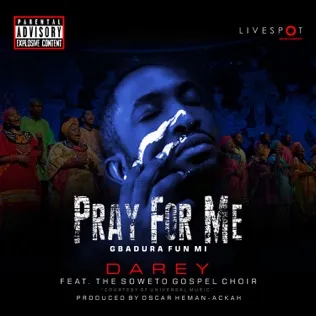
Darey + Soweto Gospel Choir - Pray For Me (Gbadura Fun Mi) Lyrics
Lyrics
Woke up one sunday morning
Told my daddy I’m leaving home
I’m going off to the city tomorrow
Even though I don’t know where to go
Daddy said son, "don’t be a fool
coz life in the city is unbelievable
you could get broken oh
you’re just a little boy
and you may never find your way".
and I said
I know I could get lost, I Know I-I-I
i know i could get broken I know I-I-I
forgive me father but I got to take a chance
and I’m already gone so just
Pray for me, (Gbadura fun mi)
pray I find my way (k’ori bamise)
oh forgive me father
but I got to take a chance
oh I’m already gone so just
Pray for me, (Gbadura fun mi)
pray I find my way (k’ori bamise)
oh forgive me father
but I got to take a chance
oh I’m already gone so just
Hello daddy how’re you doing?
hope mama’s doing ok
It’s been four years and eleven months now
(mo gbo pe aduke ti dagba olorun)
It was true what you said to me
(ah ah ah ah ah)
life in the city is unbelievable
(ah ah ah ah ah)
had to struggle just to get by everyday
and I could barely find my way
...
Video
Darey - Pray For Me ft. Soweto Gospel Choir [Official Video]
Meaning & Inspiration
Darey's "Pray For Me (Gbadura Fun Mi)," featuring the powerful Soweto Gospel Choir and released in 2016, is a profound exploration of faith, courage, and the enduring hope found in dependence on divine guidance. The song narrates a familiar yet deeply human story: a young individual’s departure from the safety of home for the daunting, unknown path of the city. The father’s cautionary words, echoing the wisdom found in Proverbs 16:9, "In their hearts humans plan their course, but the Lord establishes their steps," highlight the inherent risks and uncertainties of venturing out alone, a sentiment understandable to any parent. The protagonist acknowledges these perils, confessing, "I know I could get lost, I know I could get broken," demonstrating a mature recognition of their vulnerability, reminiscent of King David's admission in Psalm 27:10, "Though my father and mother forsake me, the Lord will receive me." This acknowledgment of potential hardship is not a statement of defeat but a prelude to a courageous leap of faith, embodied in the plea, "Forgive me father, but I got to take a chance, and I’m already gone so just pray for me."
The central theme, eloquently expressed in the Yoruba phrase "Gbadura Fun Mi" (Pray for me) and "k’ori bamise" (may my head be blessed/may my prayer be answered), centers on the absolute necessity of prayer and divine favor when embarking on a journey fraught with uncertainty. The protagonist, having made the irreversible decision to leave, understands that their success and safety are not solely reliant on their own strength or planning, but on the grace and direction of God. This echoes the sentiment in Jeremiah 29:11, "For I know the plans I have for you," declares the Lord, "plans to prosper you and not to harm you, plans to give you hope and a future." The song artfully conveys that even when we step out with a sense of determination, our ultimate well-being and ability to navigate life's complexities are entrusted to God's hands. The repeated refrain serves as a powerful reminder that in moments of transition and challenge, seeking intercession and divine enablement is not a sign of weakness, but a testament to profound faith and a recognition of our reliance on a higher power. The inclusion of the Soweto Gospel Choir amplifies this message, their robust harmonies and spiritual resonance underscoring the weight and universal truth of the plea for prayer and divine providence in every endeavor.