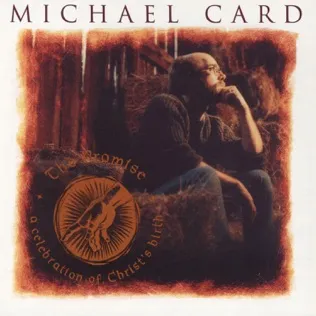
Michael Card - Shepherd's Watch Lyrics

Album: A Celebration of Christ's Birth
Released: 01 Jan 1991
iTunes Amazon Music

Lyrics

Shepherds watch, listening to lambs bleat
Tired backs, worn out and cold feet
All life long, living like outcasts
All life long, longing for life

A dazzling light the voice of an angel
Gripped with fear, terrified they fell
One like a man, yet awesome and holy
A face so fierce and yet strangely kind

"Do not be afraid, I've good news of great joy
Your Savior is come; He's Christ, the Lord
As a sign to you the One born today
Will be wrapped in rags, asleep on the hay"

And all at once the air filled with angels
Glory shone of holiness they smelled
"Glory be to God in the highest
And peace on earth to all those He loves"

"Do not be afraid, I've good news of great joy
Your Savior is come; He's Christ, the Lord
As a sign to you the one born today
Will be wrapped in rags, asleep on the hay"

"As a sign to you the One born today
Will be wrapped in rags, asleep on the hay"

Video

Shepherds' Watch

Thumbnail for Shepherd's Watch video

Meaning & Inspiration

Michael Card's "Shepherd's Watch," released on January 1, 1991, as part of his album *A Celebration of Christ's Birth*, stands as a powerful and deeply reflective musical interpretation of one of Christianity's foundational narratives. This song immediately immerses the listener in the ancient Judean hills, focusing on the oft-unheralded figures of the Christmas story: the shepherds. Card’s lyrical landscape masterfully paints a picture of these individuals – their "tired backs, worn out and cold feet," underscoring their arduous daily lives. More poignantly, the lines describing them "all life long, living like outcasts / all life long, longing for life" convey their marginalization within society, portraying them as people yearning for something more profound, perhaps for the promised Messiah who would bring true life and belonging. This intentional focus on the lowest rung of society highlights a profound theological truth: God frequently chooses the humble and overlooked to reveal His greatest works, a theme echoed in passages like 1 Corinthians 1:27-29, which states that God chose the foolish and weak things of the world to shame the wise and strong.

The narrative pivots dramatically with the arrival of the divine. Card captures the raw human terror in response to the supernatural, as "a dazzling light the voice of an angel / gripped with fear, terrified they fell." This moment is a direct reflection of the biblical account in Luke 2:9-10, where "an angel of the Lord appeared to them, and the glory of the Lord shone around them, and they were terrified. But the angel said to them, 'Do not be afraid.'" The angel’s subsequent declaration is the heart of the good news: "Do not be afraid, I've good news of great joy / Your Savior is come; He's Christ, the Lord." This announcement perfectly mirrors Luke 2:10-11, proclaiming a "Savior" who is "the Messiah, the Lord." The titles used are laden with theological significance: "Savior" speaks to redemption from sin, "Christ" identifies Jesus as the long-awaited Anointed One prophesied throughout the Old Testament (e.g., Isaiah 9:6-7), and "Lord" asserts His divine authority and sovereignty. Card’s decision to emphasize these divine titles underscores the magnitude of the infant’s true identity.

The angel’s sign, "As a sign to you the One born today / Will be wrapped in rags, asleep on the hay," directly quotes Luke 2:12, where the sign is a "baby wrapped in cloths and lying in a manger." Card’s choice of "rags" rather than simply "cloths" and "hay" for "manger" emphasizes the abject humility of the Messiah’s birth. This sign is intentionally counter-cultural and revolutionary, revealing a God who enters the world not with pomp and power, but in vulnerability and poverty. It challenges human expectations of greatness and prefigures Jesus’ entire ministry, where He consistently identified with the poor, the sick, and the outcast (Matthew 25:35-40). This deeply humble beginning is a cornerstone of Christian theology, demonstrating God’s profound love for humanity and His desire to meet us where we are, not where we pretend to be.

The song then swells with the appearance of the heavenly host, where "all at once the air filled with angels / Glory shone of holiness they smelled." This sensory detail of "holiness they smelled" vividly conveys the overwhelming, almost palpable presence of the divine, moving beyond mere sight and sound to an immersive spiritual experience. Their corporate hymn, "Glory be to God in the highest / And peace on earth to all those He loves," is a direct paraphrase of Luke 2:14: "Glory to God in the highest heaven, and on earth peace to those on whom his favor rests." This declaration is more than a seasonal wish; it is a profound proclamation of the *shalom* that Christ's birth inaugurates. This peace is not merely the absence of conflict but a holistic spiritual well-being, reconciliation with God, and an internal serenity extended to all who accept His grace. Romans 5:1 articulates this truth beautifully: "Therefore, since we have been justified through faith, we have peace with God through our Lord Jesus Christ." Michael Card's "Shepherd's Watch" is not merely a recounting of the Christmas story; it is a profound theological meditation on God's nature, His radical humility, and His universal invitation to salvation, inspiring contemplation on the true meaning of the incarnation and its revolutionary impact on humanity.

Loading...
In Queue
View Lyrics