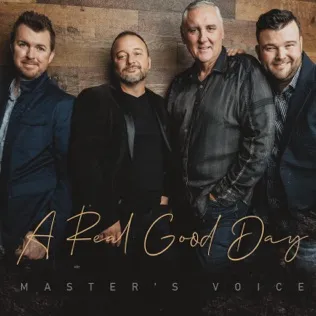
Master's Voice - Whose Hand You're In Lyrics

Album: A Real Good Day
Released: 08 Jan 2022
iTunes Amazon Music

Lyrics

You know I can't see you, I'm not worried
Because I'm assure we'll meet again
I know exactly where you are
I know whose hands your in

So many chapters in our story
And I believe that this is not the end
We'll pick off where we left off in glory
I know whose hands you're in

Chorus:
So save a place for me at the table
We'll caught up and talk about old times
We'll walk those golden roads together side by side forever
We'll have perfect peace of mind until then
Cause I know whose hands you're in

I wonder what it's like to live with Jesus
To finally be at home with Him
To look in the eyes of your Redeemer
And know whose hands you're in

I know whose hands you in

Video

Wash Your Hands | The Bath Song For Kids + more nursery rhymes by HeyKids!

Thumbnail for Whose Hand You're In video

Meaning & Inspiration

There is a specific, quiet violence in the phrase "I know whose hands you’re in."

On a literal level, Master’s Voice is singing about grief—about the physical absence of a loved one who has passed away. It’s a comfort, a way to anchor the erratic, drifting sensation of missing someone. You point toward the sky, or toward the idea of a heaven, and you define their location not by geography, but by ownership. They aren't just "gone"; they are held.

But look at the possessive possessiveness of that claim. "I know whose hands you’re in." It’s an act of naming the captor, though in this case, the captor is God. There is a strange friction here. To say someone is "in" someone else’s hands is to imply a total surrender of agency. When we lose people, our primal instinct is to try to hold them ourselves—to keep their memory, their influence, or their actual presence within the reach of our own fingers. To concede that they are in God’s hands is to admit that they are entirely out of ours.

Is that a cliché? In the lexicon of gospel music, "in His hands" is the go-to line, a soft pillow for the grieving. But when you strip away the music and look at the words on the page, it stops feeling soft. It feels like a boundary. It’s a border patrol for the soul.

Scripture speaks of this, though it’s rarely as gentle as a lullaby. In John 10:28, Jesus says, "I give them eternal life, and they shall never perish; no one will snatch them out of my hand." That’s not a comforting static image; that’s a promise of protection against theft. It suggests that death is a battleground, and the only way to be safe is to be physically grasped by the Creator.

The tension that sticks with me is the contrast between the "table" mentioned in the chorus and the "hands" mentioned in the refrain. A table is a place of equality, of conversation, of catching up on "old times." It’s humanizing. But the hands? The hands are the place of origin and the place of finality. If you are in someone’s hands, you are not really at a table yet; you are being carried.

I find myself wondering if we use this phrase to soothe ourselves because the alternative—that they are simply nowhere, or that we have no idea where they are—is too cold to carry into a Tuesday morning. We map the afterlife onto the anatomy of God because we need our loved ones to have a destination. We don't just want them to be "safe"; we want them to be held.

It leaves me uneasy. It is a bold, presumptuous thing to claim to know the exact location of the dead. Yet, reading these lyrics, I realize that perhaps the presumption isn't a flaw—it’s the only way to survive the vacancy they leave behind. You build a theology out of your own desperation. You decide where they are so that you can decide how to keep living. It isn't a finished thought; it's a desperate, anchored hope.

Loading...
In Queue
View Lyrics